A global spotlight on autophagy and neuromuscular disorders
In an inspiring example of scientific dedication and European collaboration, Eline Lemerle, postdoctoral researcher at the Centre de Recherche en Myologie (CRM), INSERM / Sorbonne Université, has been awarded the Elsevier Poster Prize at the World Muscle Society (WMS) 2025 congress. Her presentation – “Development of a standardized toolbox for autophagy research in neuromuscular disorders” – captured the attention of the international jury for its innovative approach, methodological precision, and potential to transform how scientists study muscle degeneration and repair.
This distinction places Lemerle and the DREAMS project firmly on the global stage of neuromuscular research. Her work not only deepens our understanding of how muscle cells regenerate and maintain themselves but also contributes directly to DREAMS’ overarching goal: to accelerate the discovery of safe and effective therapies for rare neuromuscular disorders (NMDs) through the power of Artificial Intelligence (AI), stem cell science, and pharmacological innovation.
Understanding the cellular machinery: why autophagy matters
Autophagy, meaning “self-eating” in Greek, is the cell’s way of cleaning up and recycling its own damaged components, an essential process for cellular health and energy balance. When autophagy malfunctions, waste accumulates inside cells, leading to progressive damage. In muscle cells, this dysfunction is a known driver of several rare neuromuscular disorders, such as Duchenne muscular dystrophy (DMD), Centronuclear myopathy (CNM), Pompe disease, and Danon disease.
Despite its importance, studying autophagy has long been a challenge. Research groups often rely on different laboratory methods, making it difficult to compare results or identify patterns across diseases. This is where Eline Lemerle’s work within DREAMS stands out. By developing a standardized research toolbox for autophagy analysis – using skeletal muscle cells derived from induced pluripotent stem cells (iPSCs) – her project provides a harmonised framework that can be shared among laboratories.
This toolbox will make it possible to systematically measure autophagy activity, identify common cellular signatures across multiple NMDs, and feed these data into DREAMS’ AI-powered discovery platform. The result: a more integrated understanding of disease mechanisms and a clearer pathway to repurpose existing drugs or design new therapeutic molecules more efficiently.
“It is very rewarding to see a project that bridges multiple neuromuscular disorders receive such recognition. This distinction underscores the value of collaborative approaches and the promising outlook for future NMD research” – Eline Lemerle
Bridging biology and technology: DREAMS’ innovative model
DREAMS, Drug Repurposing with Artificial Intelligence for Muscular Disorders, is funded by the European Union’s Horizon Europe programme. The project’s mission is ambitious: to establish a reusable, AI-driven platform that combines cellular assays, big data, and machine learning to uncover treatment opportunities across multiple rare neuromuscular diseases.
This integrative approach is a game-changer. Traditional drug discovery can take over a decade and cost billions of euros, with a high failure rate in clinical phases. DREAMS aims to drastically shorten that timeline by using AI algorithms to analyse biological data from iPSC-derived muscle cells, identify promising drug targets, and predict how existing compounds might interact with those targets.
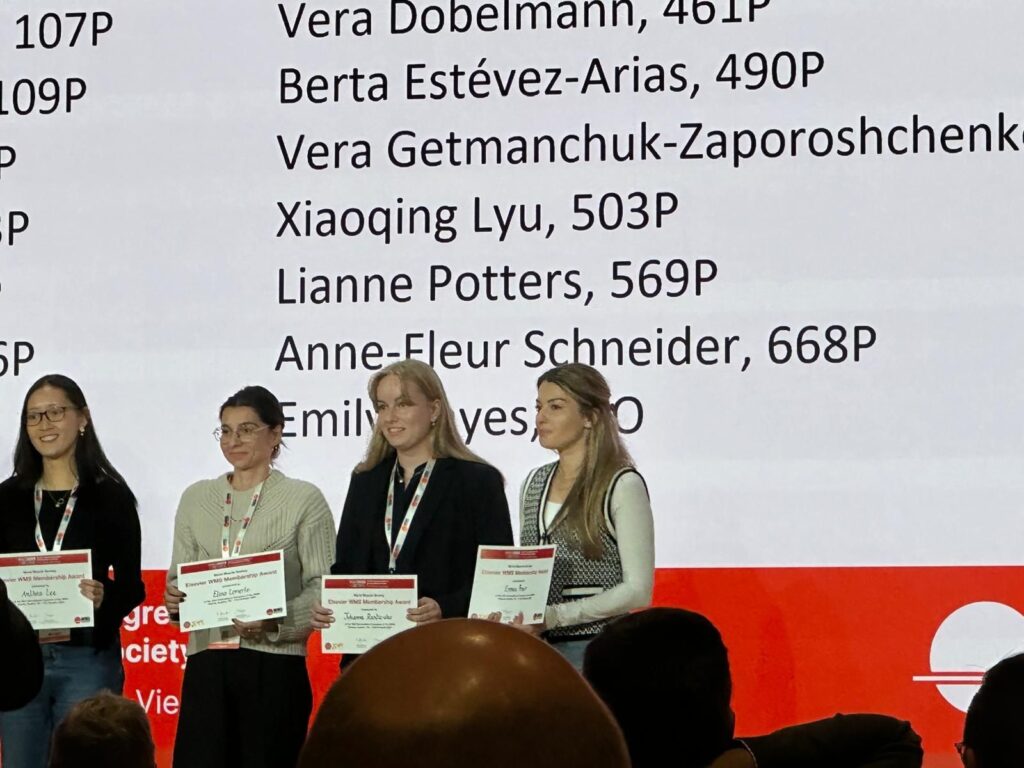 Eline Lemerle receiving the award. Photo from Centre de Recherche en Mylogie
Lemerle’s contribution, providing high-quality, standardised biological data, is fundamental to this process. AI models are only as powerful as the data they learn from; the precision and reproducibility of her work enhance the accuracy of the entire DREAMS platform. Together, this synergy of biology and technology represents a new paradigm for cost-effective, ethical, and patient-centred drug discovery in rare diseases.
From laboratory to life: why this award matters
The recognition at WMS2025 goes beyond an individual accolade – it symbolises the collective progress of the DREAMS consortium and the broader European scientific community. For patients living with rare neuromuscular disorders, every methodological advance brings hope. These diseases often have no cure, limited treatment options, and affect only a few hundred or thousand people globally.
Because of their rarity, conventional clinical trial designs and large patient cohorts are often not feasible. DREAMS addresses this challenge by developing adaptive clinical trial strategies, allowing smaller, more diverse patient populations to participate effectively in testing new therapies. By coupling this with AI-supported analysis and patient-driven research, the project ensures that innovation does not remain confined to the laboratory – it moves toward tangible benefits for real people.
European collaboration at its best
The success celebrated in Lyon at the World Muscle Society congress is the result of teamwork across Europe. DREAMS brings together nine partner organisations from six countries, each contributing specialised expertise – from stem cell biology and pharmacology to computational science and clinical medicine.
The project is coordinated by the CECS/I-Stem Institute (Centre d’Études des Cellules Souches) and includes partners such as INSERM, Kantify, and leading research institutions focused on muscle physiology and data science. This cross-disciplinary model not only enhances research quality but also demonstrates how EU-funded collaboration can amplify scientific impact while promoting open science and knowledge sharing.
In this sense, Lemerle’s award is a reflection of the entire consortium’s dedication. It represents what can be achieved when curiosity, technology, and human collaboration converge toward a common purpose: improving lives through innovation.
Looking ahead
The next phase of DREAMS will focus on validating candidate drugs identified by its AI models and preparing for clinical testing through adaptive protocols. Lemerle’s standardized autophagy toolbox will play a central role in ensuring these preclinical evaluations are robust, reproducible, and translatable to patient contexts.
As Europe continues to champion research excellence under Horizon Europe, initiatives like DREAMS serve as a blueprint for the future – where data and compassion work hand in hand, and every scientific milestone brings society one step closer to equitable healthcare for all.
At its heart, this story is about more than an award. It is a testament to the power of collaboration, perseverance, and vision. When science becomes truly inclusive and interdisciplinary, breakthroughs like this cease to be isolated moments of success – they become stepping stones toward lasting change.
