The Promise and Paradox of Drug Repurposing
Drug repurposing is transforming rare disease research. By bypassing the lengthy process of developing entirely new compounds, researchers evaluate whether existing, approved medicines can target other pathologies. For the millions of patients awaiting treatment, this approach offers a critical shortcut.
Yet, conventional development pathways remain nearly impossible to sustain in ultra-rare populations. Recruiting sufficient participants is incredibly difficult, clinical expertise is highly fragmented across borders, and a stark lack of natural history data persists. These structural constraints deeply impact every stage of research, from preclinical validation to regulatory approval.
This is why drug repurposing has gained significant momentum over the last decade. By leveraging existing assets, researchers can tap into a wealth of pre-existing data:
- Known safety profiles and toxicological history
- Established pharmacokinetic data (how the drug moves through the body)
- Existing manufacturing and supply pathways
- Prior regulatory approvals and extensive clinical experience
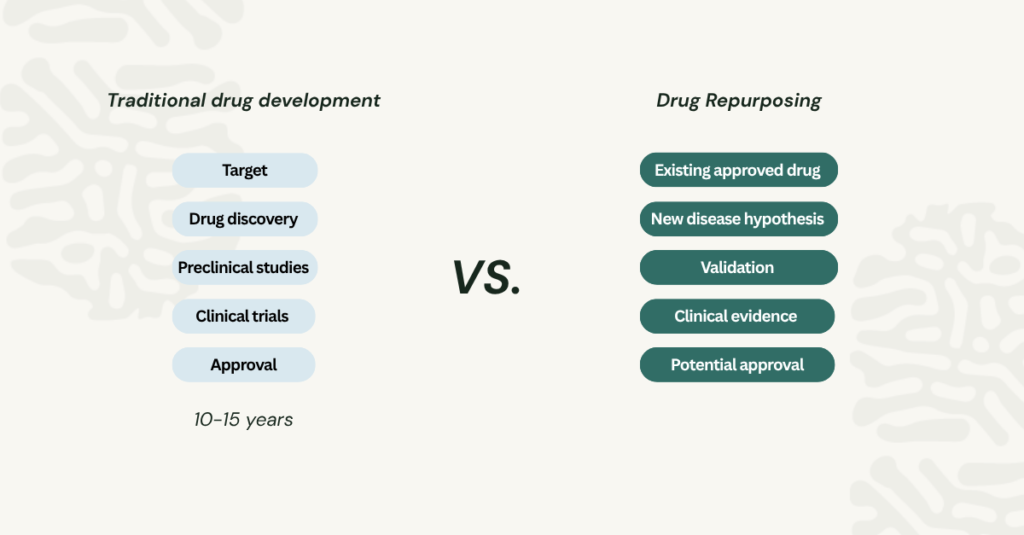
While these factors drastically reduce uncertainty during early development, repurposing is not a shortcut around disease-specific validation. A drug that works in one condition cannot simply be assumed to work in another. Mechanisms of action, dose-response relationships, biomarkers, patient populations, and expected clinical outcomes must be entirely reassessed for the new target disease.
In rare diseases, this task is further complicated by small, highly heterogeneous patient populations where disease trajectories vary drastically from one patient to another. Consequently, capturing and interpreting a clear therapeutic signal is rarely straightforward.
The Data Dilemma in Small Patient Populations
Evaluating a drug when only a few dozen patients worldwide can participate changes the rules of clinical research. In rare diseases, the core challenge isn’t just finding patients; it is extracting meaningful, interpretable data from tiny, highly diverse groups.
Standard clinical trials rely on massive datasets to drown out statistical noise. Rare disease research rarely has that luxury. Instead, investigators frequently operate without validated biomarkers, harmonized outcome measures, or robust natural history data to serve as a baseline.
This constraint is particularly acute in neuromuscular and neurogenetic disorders. A single clinical trial might include patients at completely different stages of disease progression. Consequently, traditional endpoints, whether they are functional scales, respiratory assessments, or muscle imaging, become moving targets. A therapeutic signal that would be obvious in a large-scale trial gets lost in individual patient variability, making it incredibly difficult to prove to regulatory bodies that a drug works.
Natural History: The Baseline for Innovation
Without a clear map of how a disease progresses over time, evaluating a new treatment is nearly impossible. This is why robust natural history data is a necessity, not a luxury. Longitudinal datasets provide the baseline that researchers desperately need to define expected disease trajectories, select the right clinical endpoints, and accurately interpret patient responses.
When this baseline is missing, the entire development pipeline stalls, stretching from early translational research to final regulatory reviews.
To break this bottleneck, the rare disease community is shifting towards shared, high-quality data infrastructures. Current efforts focus on building international longitudinal registries, harmonizing clinical endpoints, and qualifying robust biomarkers. Rather than working in silos, the goal is to construct reproducible disease models that give clinical trials a solid framework to measure success.
The Fragmentation Trap: Scattered Data, Lost Opportunities
The bottleneck in rare disease research isn’t just a lack of data; it is that existing data is deeply fragmented. Because many repurposing trials are small, investigator-driven, or published outside standard academic journals, their findings often sit untracked in conference abstracts or registry databases.
This creates an invisible evidence landscape. When clinical results vary wildly in design and cannot be easily compared, building cumulative knowledge stalls. The scientific community loses invaluable opportunities to learn from both breakthroughs and failures, leading to a costly duplication of efforts.
In a field where every single patient’s data is precious, this fragmentation is a luxury we cannot afford. The challenge is not simply to generate more studies, but to fundamentally improve how clinical evidence is structured, harmonized, and integrated.
From Prediction to Approval: The Intellectual Property Wall
Discovering a promising early signal is only the first step; translating it into regulatory success is where many programs fail. This is especially true for generic or off-patent medicines. Even when strong biological evidence exists, the lack of sustainable intellectual property (IP) protection reduces incentives for industry to invest in the large, costly trials required for formal marketing authorization. As a result, many valuable hypotheses remain stuck between proof-of-concept and clinical implementation.
AI: Driving Discovery, Facing the Clinical Wall
This is where computational approaches and Artificial Intelligence (AI) are changing the game. Within the DREAMS project, AI-assisted tools excel at identifying shared biological pathways and predicting which approved drugs can be redirected toward rare muscular disorders.
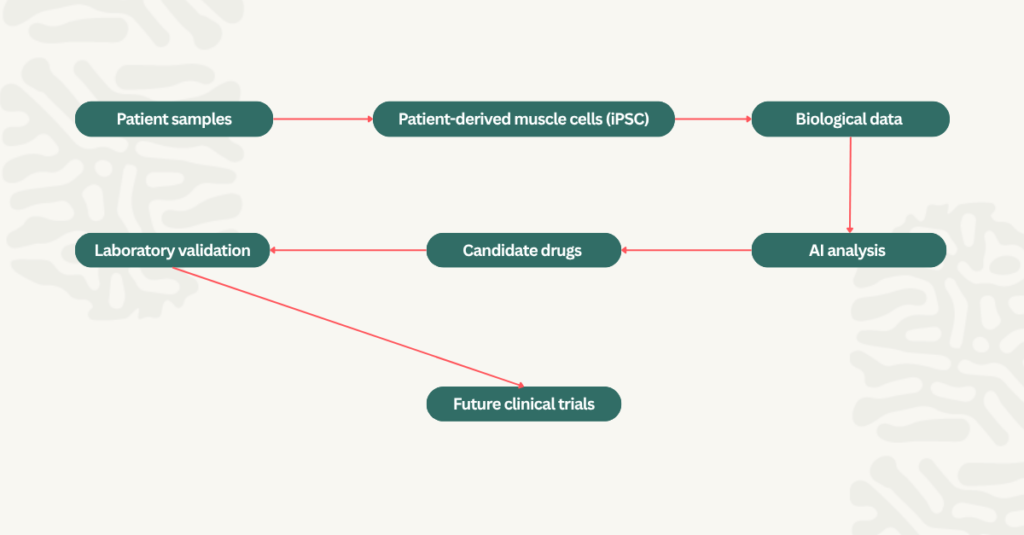
Yet, computational prediction alone is not clinical evidence. The real bottleneck appears immediately after: proving safety and efficacy through conventional clinical trials. For ultra-rare conditions, standard trial designs simply fail. Researchers hit a brick wall of operational obstacles: an extreme scarcity of patients, a total absence of validated endpoints, and zero natural history data to lean on. To prevent AI-discovered treatments from staying locked in laboratories, the rules of clinical evidence generation must evolve.
Beyond Classic Trials: Smarter Frameworks for Ultra-Rare Diseases
Instead of forcing rare diseases into conventional trial designs, the scientific community must leverage agile, patient-centric alternatives:
- N-of-1 Trials: These single-patient trials focus entirely on the individual. By using the patient as their own control through rigorous, repeated periods of treatment and withdrawal, they generate high-quality statistical evidence from a sample size of one.
- Structured Compassionate Use: Instead of managing early access on a purely administrative basis, treating patients through compassionate pathways can become a vital source of Real-World Evidence (RWE), provided that safety and efficacy metrics are rigorously tracked.
- Adaptive Trial Designs: Modifying trial parameters in real-time based on interim data allows researchers to maximize the insights gained from very small patient cohorts.
Drug repurposing is often presented as a faster path to new therapies. In reality, identifying a promising molecule is only the beginning. The real challenge lies in generating robust clinical evidence that can translate scientific predictions into treatments that reach patients. Projects such as DREAMS contribute to this transition by combining AI, patient-derived models and innovative clinical research approaches to address one of the most persistent challenges in rare disease research.
