Munich recently hosted the 3rd International Conference on Systems Medicine, Artificial Intelligence, and Drug Repurposing, known as RExPO24. This event was organized by the Horizon Europe project REPO4EU, which is currently developing a European/Global Platform and Infrastructure for Drug Repurposing.
The DREAMS project had the honor of being represented by two esteemed figures: Nik Subramanian, Co-founder and CTO of Kantify, and Xavier Nissan, Research Director at CECS/I-Stem and DREAMS project coordinator. Both experts addressed critical topics such as systems medicine, drug repositioning, and AI—areas that are closely aligned with the project’s goals and strategic objectives.
The conference brought together academics, biotech companies, and pharmaceutical firms, who presented their findings, algorithms, and challenges in drug repositioning. DREAMS’ involvement in RExPO24 proved to be highly advantageous, providing a platform to showcase innovative methodologies and foster valuable connections that are expected to drive significant advancements in the treatment of rare diseases.
Drug Repurposing: Transforming Treatment Approaches
Drug Repurposing, also known as drug repositioning, is the process of finding new therapeutic uses for existing medications that were originally developed for different diseases. This approach leverages previously approved or investigated pharmacological compounds for new clinical applications.
This method can be faster and less expensive than developing new drugs from scratch, as it utilizes compounds whose safety and pharmacokinetics have already been studied. Approved drugs have a known safety profile, which reduces development risks and increases the likelihood of success in new indications.
Drug repurposing enables the discovery of effective treatments within the existing library of approved medications, offering new therapeutic options for rare diseases that lacked treatments before.
Drug repurposing plays a crucial role in expanding the therapeutic options available to patients, especially for rare, chronic, and challenging diseases. It enables the discovery of effective treatments within the existing library of approved medications, providing therapeutic options where there were none before.
DREAMS’ Impact and Contributions at RExPO24
Key partners from the DREAMS project, Nik Subramanian (Kantify) and Xavier Nissan (CECS/I-Stem), took center stage at RExPO24, each leading insightful sessions.
Kantify presented a case study on their AI-first approach to target and drug discovery within the DREAMS project, with a focus on oncology.
“We showcased an alternative method for drug repositioning, differing from standard practices in research and industry. The feedback and collaboration requests we received were remarkable,” said Nik Subramanian.
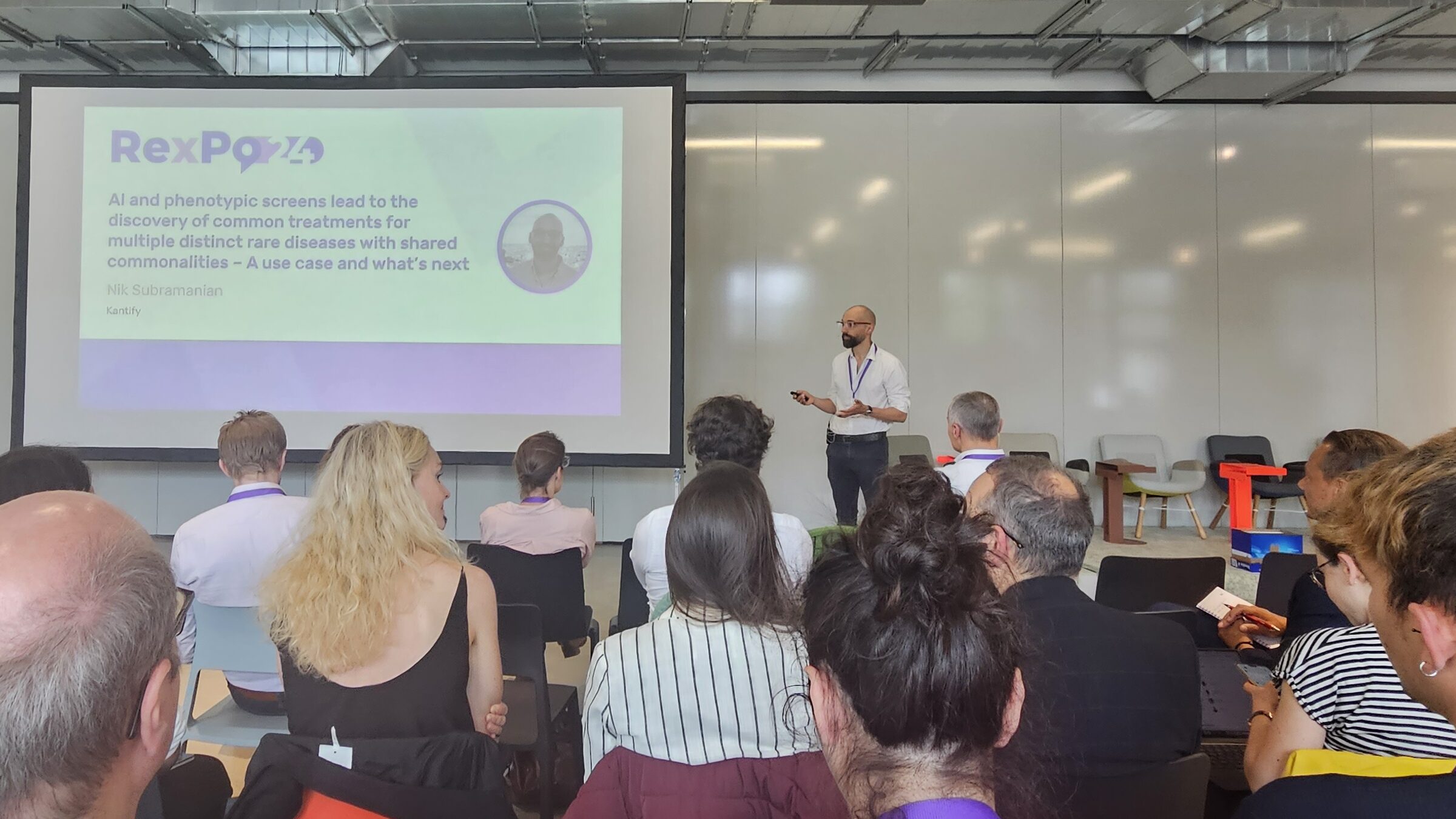 Nik Subramanian, Co-founder and CTO of Kantify, during his intervention at RExPO.
CECS/I-Stem, on the other hand, introduced the DREAMS project and delivered a resentation on drug repositioning and stem cells, highlighting the importance of this innovative technique for treating various diseases.
Xavier Nissan noted that the meeting underscored the necessity of using omics data and interactome analysis to enhance drug repurposing strategies. This approach allows for a deeper understanding of biological interactions and more precise treatment targeting.
“My presentation emphasized how drug repurposing, combined with the use of stem cells, can accelerate the development of effective and personalized therapies,” explained Xavier Nissan. “These discussions are set to significantly impact the scientific community, fostering collaboration and the emergence of new ideas for rare diseases”.
DREAMS’ involvement in RexPO24 was highly advantageous for the project, offering a platform to highlight innovative methodologies and fostering valuable connections that are set to propel future advancements in rare disease treatments.
