The landscape of neuromuscular research is undergoing a profound transformation. Advances in stem-cell-based modelling, multi-omics data integration and artificial intelligence (AI) are opening new pathways for understanding—and treating—rare neuromuscular disorders (NMDs). Against this backdrop, the DREAMS consortium stepped into the spotlight at the 22ᵉ Journées de la Société Française de Myologie (JSFM2025), held this week in Aix-les-Bains.
As one of the most respected myology conferences in France and Europe, JSFM2025 brought together scientists, clinicians, patient representatives and technology innovators. For DREAMS, the event marked a key opportunity to share its latest progress, exchange with experts and elevate the visibility of a project that aims to redefine how therapies for rare NMDs are discovered.
Cross-Disease Insights Through Multi-Omics: A Key Contribution
A highlight of DREAMS’ participation was the oral presentation by Hassan Hayat, PhD student and emerging voice within the consortium. His talk, “Cross-disease identification of shared therapeutic targets in myopathies via multi-omics integration and network inference within the consortium DREAMS,” addressed one of the most ambitious challenges in neuromuscular research: understanding what connects different myopathies at the molecular level.
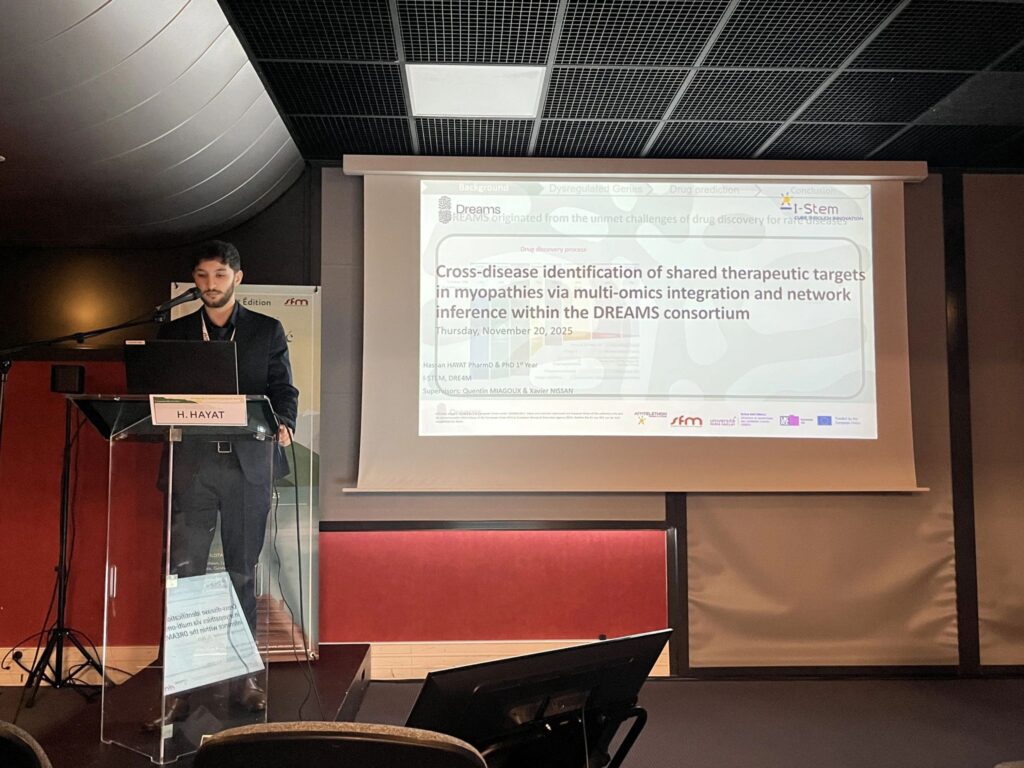
Traditional research often examines rare diseases independently, constrained by limited patient numbers and fragmented datasets. But DREAMS is embracing a different philosophy—one that focuses on common biological mechanisms shared across multiple disorders. This strategic shift has the potential to accelerate therapeutic development by identifying pathways that can be targeted in more than one condition.
Hayat’s work integrates genomic, transcriptomic, proteomic and cellular-level data to uncover these shared signatures. The research focuses on five genetically defined NMDs that DREAMS has prioritised: Centronuclear Myopathy (CNM), Duchenne Muscular Dystrophy (DMD), Emery-Dreifuss Muscular Dystrophy type 2 (EDMD2), Pompe Disease and Danon Disease .
Although distinct in genetic cause, these disorders often share disrupted cellular processes, such as autophagy dysfunction and desmin disorganisation—two hallmarks that DREAMS has identified as cross-disease features . By mapping these converging mechanisms, Hayat’s research helps reveal candidate therapeutic targets that could have broader impact across patient groups.
Why this approach matters
Multi-omics integration enables scientists to see patterns invisible to single-dataset analyses. It strengthens the rationale for drug repurposing—particularly important given DREAMS’ mission to develop faster, more efficient and more cost-effective therapies. It also aligns with the project’s vision of creating a reusable platform that could benefit not just one disease community, but many.
Hayat’s presentation at JSFM2025 reflected this scientific ambition and demonstrated the strength of DREAMS’ integrated approach combining advanced cellular models, data-rich analyses and machine learning .
A Clear and Accessible Overview of DREAMS’ Vision
In parallel to the oral session, Quentin Miagoux presented the poster “DREAMS – Drug REpurposing with Artificial Intelligence for Muscular disorderS.” His poster provided an accessible summary of the project’s structure, objectives and methodology.
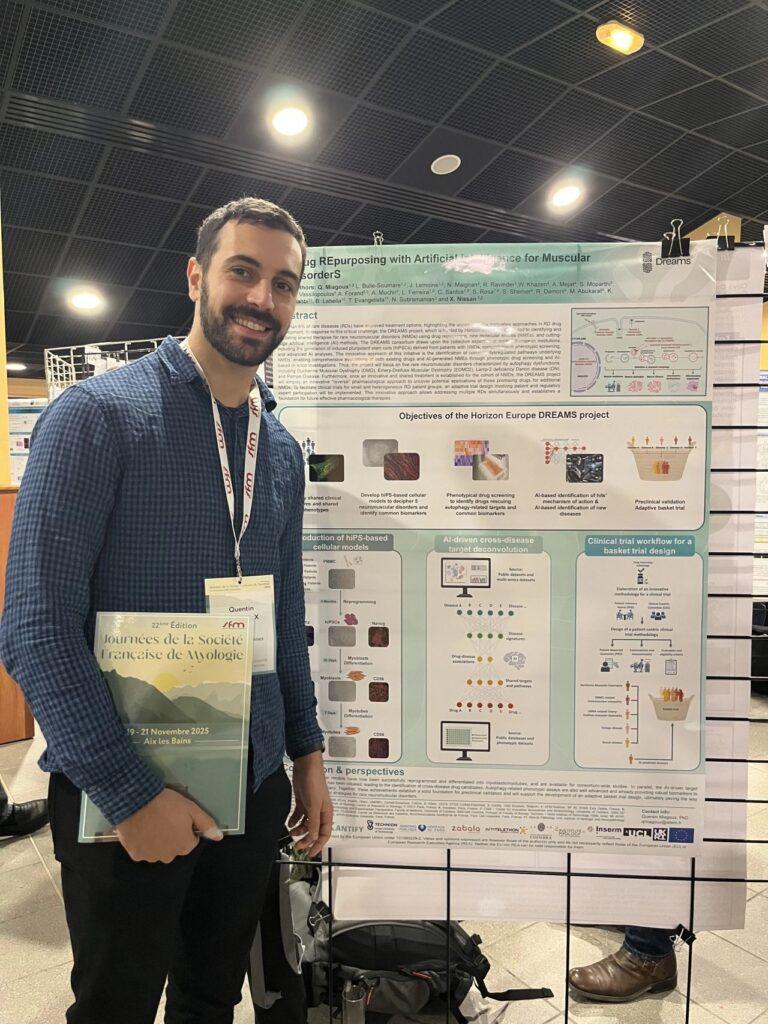
At its core, DREAMS stands on three pillars:
1. Generating relevant disease models and data
The project develops specialised cellular assays using skeletal muscle cells derived from induced pluripotent stem cells (iPSCs). These models enable scientists to observe the early mechanisms of neuromuscular disorders and generate high-quality data that feed into the AI algorithms .
2. Leveraging artificial intelligence for drug discovery
AI and machine learning models are crucial tools in DREAMS’ strategy. By analysing large biological datasets, AI helps accelerate both target discovery and molecule identification, reducing cost and lowering the risk of failure linked to off-target effects or toxicity . Through this unique integration, DREAMS aims to develop the first reusable iPSC/AI platform for identifying therapies for rare neuromuscular disorders .
3. Preparing for adaptive clinical trials
Given the limited and heterogeneous patient populations typical of rare diseases, conventional clinical trial designs are often impractical. DREAMS is therefore developing innovative adaptive methodologies that can evaluate candidate therapies more efficiently and more inclusively .
Miagoux’s poster effectively translated this complex scientific ecosystem into a visual narrative that resonated with researchers and clinicians visiting the poster hall.
Celebrating Early-Career Leadership in DREAMS
The participation of Hayat and Miagoux at JSFM2025 illustrates one of DREAMS’ strengths: its commitment to nurturing young scientific talent. The consortium brings together nine organisations across six countries—academic groups, clinical centres and industry partners —and early-career researchers are at the heart of its innovation engine.
Their contributions inject fresh perspectives, foster multidisciplinary collaboration and strengthen Europe’s long-term capabilities in neuromuscular research, AI-driven discovery and translational science. Supporting these emerging scientists is not only beneficial for the project but essential for ensuring that the next generation of researchers can continue to push the field forward.
A Vibrant Exchange With the Myology Community
DREAMS’ presence at JSFM2025 sparked dynamic conversations with experts in muscle biology, bioinformatics, pathology and clinical care. These exchanges highlighted several shared priorities across the community:
- The need for integrative approaches that combine computational and experimental methods
- The value of cross-disease perspectives in uncovering therapeutic opportunities
- The importance of bridging basic research with future clinical application
- The urgency of finding cost-effective solutions for disorders with no current treatments
The reception of DREAMS’ contributions underlined the growing interest in multi-omics and AI as powerful accelerators of scientific discovery in myology.
Looking Ahead: Momentum for 2025 and Beyond
The work presented at JSFM2025 represents only the beginning of DREAMS’ scientific journey. In the coming months, the consortium will continue to refine its multi-omics pipelines, integrate new datasets, develop more robust AI models and advance the design of adaptive clinical strategies.
Collaborations with clinicians and patient organisations will remain essential, ensuring that scientific breakthroughs translate into meaningful benefits for those most affected by rare neuromuscular disorders. DREAMS’ long-term vision is clear: to create a scalable, reusable and patient-centred framework capable of accelerating therapy development—not just for the five diseases within the project’s scope, but for a much wider range of rare conditions.
Events like JSFM2025 play a crucial role in this mission. They provide a platform for sharing knowledge, strengthening the scientific network and validating the project’s direction. DREAMS’ active engagement at this year’s edition confirms the consortium’s steady progress and its growing influence within the neuromuscular research landscape.
As we look toward the future, the message from Aix-les-Bains is one of optimism, collaboration and scientific determination. The momentum behind DREAMS continues to build—and the contributions shared at JSFM2025 are yet another step towards delivering faster, smarter and more accessible therapies for rare neuromuscular diseases.
